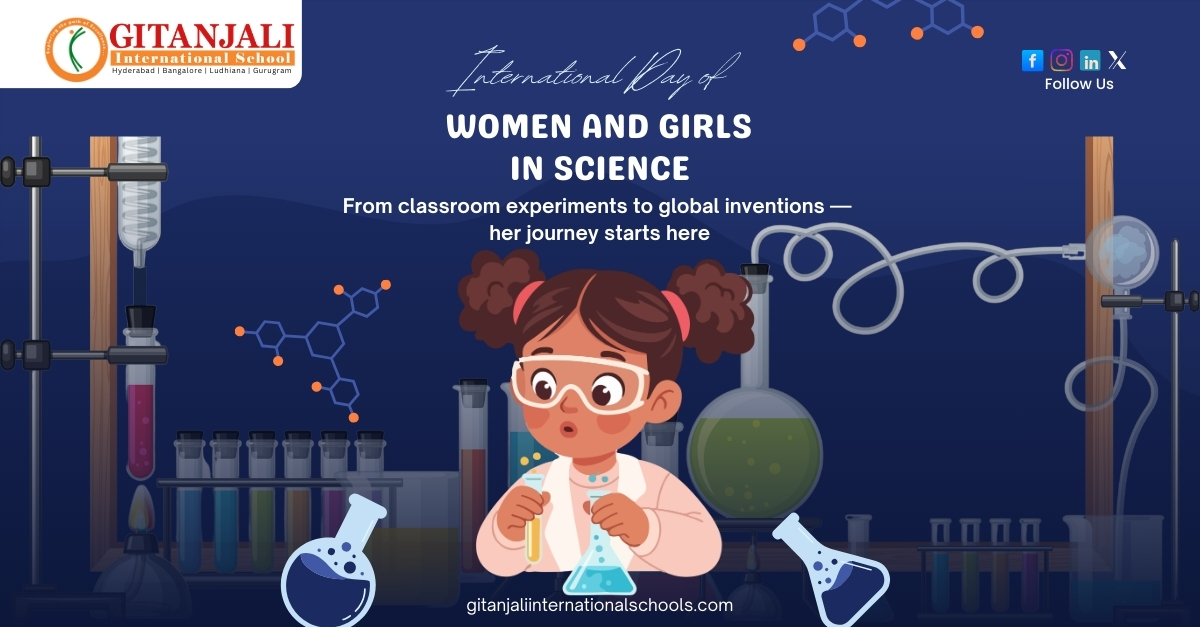
The world needs scientific literacy as its essential foundation because artificial intelligence and climate research and biotechnology and space exploration shape the modern world. UNESCO research shows that women constitute less than 30 percent of the total global research workforce.
The United Nations International Day of Women and Girls in Science serves as more than a day of remembrance. The worldwide movement demands that educational systems create equal opportunities for all students to study STEM fields while developing proper representation for their academic needs.
Gitanjali International School in Sushant Lok 2 Gurgaon shows its dedication through actual school operations not through symbolic gestures. The school uses its academic framework and classroom techniques and school leadership programs as tools which create their daily educational experience.
The Global STEM Gender Gap: A Developmental Priority
The 21st-century economy requires innovation as its driving force. Countries invest heavily in scientific research to develop solutions for climate change problems and renewable energy needs and global health and vaccine development and cybersecurity protection and artificial intelligence systems and sustainable infrastructure.
Research shows that scientifically diverse and gender-balanced research teams produce better solutions and achieve better results in problem-solving.
The STEM gender gap exists as a social problem which countries need to solve because they require it for their development. Early science exploration for girls helps develop economic resilience and research productivity and technological progress.
Why This Conversation Matters More Than Ever
The current discussion holds greater significance than any previous point in history. Students today need to develop skills which will serve them in future careers that have not yet been established. The new fields of data science and robotics engineering and environmental analytics and space technology and biomedical research require their professionals to possess skills in analytical reasoning and computational skills and ethical science practices.
The lack of early support and introduction to these fields prevents many talented students from pursuing these career paths. Students develop scientific confidence through their foundational education which includes guidance and learning from experienced professionals and observing successful scientists.
The educational system serves as the key factor which determines how students will stay involved with STEM fields throughout their lives.
Education as the Bridge Between Awareness and Action
Meaningful science education moves beyond theory. It connects textbook knowledge to real-world applications.
At Gitanjali International School, scientific learning integrates:
- Inquiry-based classroom methodology
- Lab experimentation and hypothesis testing
- Robotics and coding modules
- Interdisciplinary STEM projects
- Research presentations and exhibitions
Such experiential models help students understand that science is not abstract — it is a tool to solve human challenges.
As a forward-thinking school in Sushant Lok 2 Gurgaon, the institution ensures that girls actively participate in leadership roles within science exhibitions, innovation challenges, and technology-driven projects.
Representation is normalized. Confidence is cultivated. Curiosity is celebrated.
Long-Term Impact: Preparing Future-Ready Global Contributors
The implementation of inclusive STEM education programs leads to multiple benefits because it enhances innovative capabilities while creating a diverse workforce that can solve social challenges and drive economic development.
The International Day of Women and Girls in Science serves as a reminder that all people possess talent which needs to be matched by equal access to opportunities.
At Gitanjali International School, scientific thinking is developed through ethical training and collaborative learning and global citizenship programs which ensure students achieve exam success while developing essential skills for their future careers.
Moving Forward: Science Without Barriers
The future needs all laboratories and boardrooms to adopt collaborative and empathetic methods of creating new solutions which include diverse human perspectives. The goal of empowering girls through science education goes beyond increasing statistical numbers because it aims to develop their full potential.
On International Day of Women and Girls in Science, classrooms that support unlimited curiosity create an environment which leads to scientific breakthroughs.The path starts at educational institutions which dedicate themselves to achieving excellence through equitable practices and hands-on learning experiences.
FAQs
- What is the International Day of Women and Girls in Science?It is a global observance recognized by the United Nations to promote equal access and participation of women and girls in STEM fields.
- How can schools support girls in STEM?
Through hands-on learning, mentorship, science projects, and leadership opportunities. - How does STEM education prepare students for the future?
It develops adaptability, innovation mindset, and digital literacy for evolving global careers.